Table of Contents
- Why automated rent reminders cut late payments
- The reminder ladder that works in Kenya
- SMS, email, or WhatsApp — which and when
- Writing a reminder that gets paid, not argued with
- Don't chase tenants who've already paid
- Setting it up in Pangoni
- A quick note on consent and data protection
- Frequently Asked Questions
Most late rent in Kenya isn't deliberate. Tenants forget, rent day falls before payday, or the M-Pesa transfer stays on their to-do list a day too long. The fastest, cheapest lever a landlord has to fix this is automated rent reminders — a scheduled nudge on the right channel, in the right tone, at the right time.
This guide walks through the reminder schedule most Kenyan landlords find actually works, which channel to send on, how to write a reminder that gets a payment (not an argument), and how to set the whole thing up in Pangoni. For the product overview, see the Automated Rent Reminders feature page.
Why automated rent reminders cut late payments
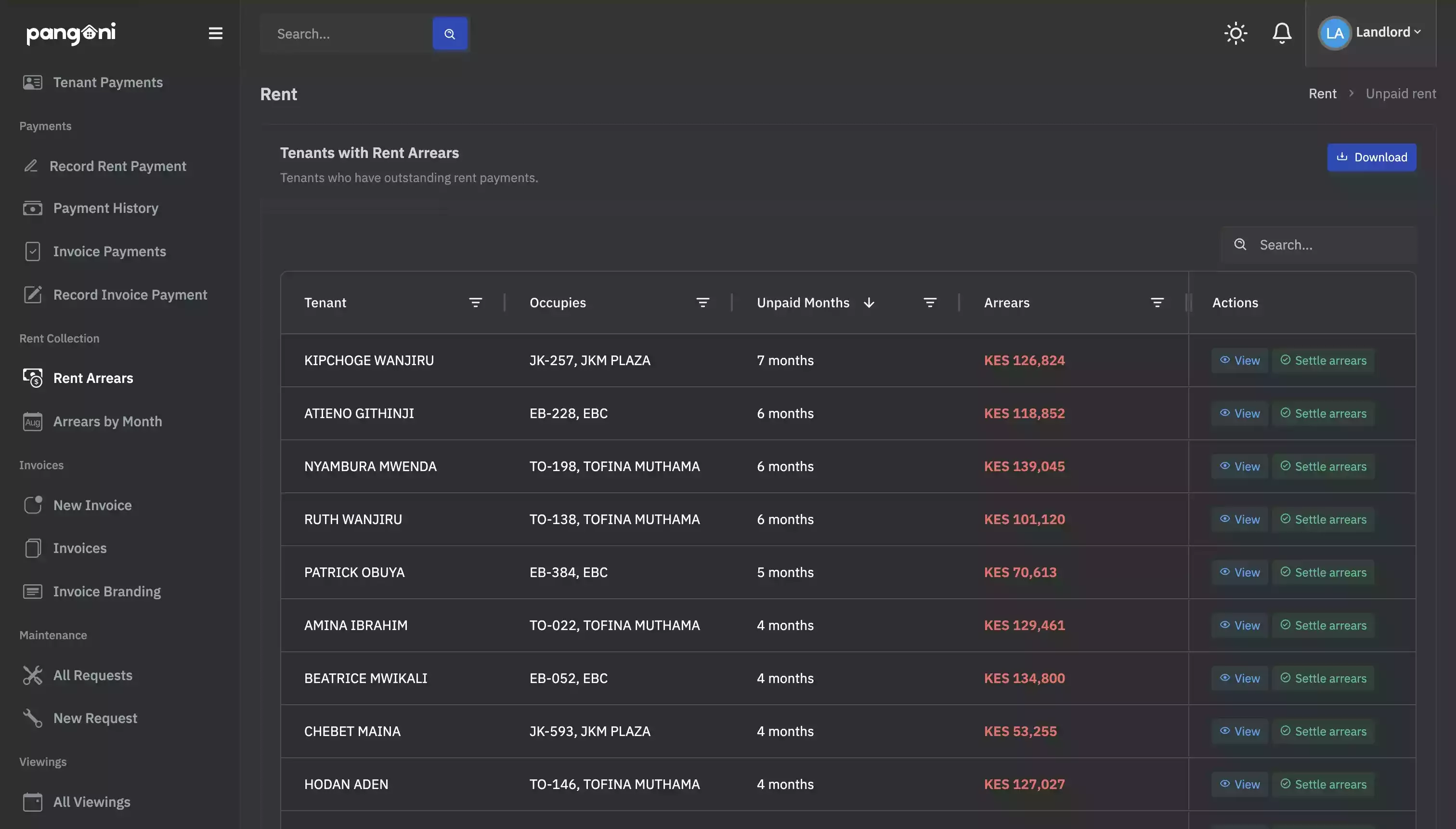
A single SMS sent on the right day does three things at once: it reminds the tenant, it gives them the M-Pesa details they need, and it removes the friction that causes most late payments — the tenant looking up your Paybill and account number. When that friction disappears, tenants pay faster. Landlords using automated reminders commonly see a meaningful drop in arrears within the first two or three billing cycles.
Automation also matters because reminders work best when they're boring. Manual reminders slip when you're busy. Automated ones don't.
The reminder ladder that works in Kenya
Start with this default and adjust. The "reminder ladder" is the sequence of messages, from first nudge to arrears notice:
- 3 days before due. Tone: friendly heads-up. Purpose: prompt the tenant to move money from wherever it lives into M-Pesa.
- On the due date. Tone: neutral. Purpose: the tenant has today to pay; here's the Paybill and account number.
- 1 day after. Tone: still neutral, but firmer. Mentions late-fee terms if your lease has them.
- 3 days after. Tone: factual. Arrears is now the word.
- 7 days after. Tone: formal notice. This message becomes part of your paper trail if the matter ever reaches the Rent Tribunal.
- 14 days after — escalate. The system notifies you (or the property manager) that this tenant now needs a human conversation, with the full payment history attached.
Adjust for your own context: student hostels on quarterly billing need reminders further out, commercial tenancies on 30-day terms typically need fewer but more formal messages.
SMS, email, or WhatsApp — which and when
Rule of thumb for Kenya: send reminders by SMS, send receipts and statements by email, use WhatsApp where your tenant actually lives.
- SMS — highest delivery and read rates. Best for the reminder itself. Keep it under 160 characters so it doesn't split across messages.
- Email — best for the monthly statement, the receipt after payment, and anything that needs a PDF attachment.
- WhatsApp — increasingly the place Kenyan tenants read anything. Pangoni's WhatsApp Business integration makes this available for landlords whose tenants respond there faster than anywhere else.
Writing a reminder that gets paid, not argued with
The best rent reminders do four things: name the tenant, name the unit, state the amount, and give the exact payment details. Everything else is decoration.
Good (English):
Hi Jane, a friendly reminder that rent for Apt B4 (Ksh 25,000) is due on 1 April. Pay via M-Pesa Paybill 247247, Account: B4. Thanks — Kamau Properties.
Good (Swahili):
Habari Jane, hii ni reminder kuhusu rent ya Apt B4 — Ksh 25,000 inaanza tarehe 1 Apr. Lipa kwa M-Pesa Paybill 247247, Acc: B4. Asante. — Kamau Properties.
Skip the passive aggression. "This is the third time we have written to you…" at the top of a first reminder burns goodwill and doesn't move money faster. Save firm language for the arrears notices.
Don't chase tenants who've already paid
Nothing erodes trust faster than reminding a tenant to pay rent they paid four days ago. This is where automated reminders and automated reconciliation work best as a pair: the moment Pangoni matches a tenant's M-Pesa to the right invoice, the reminder ladder for that lease stops. Paid tenants never get chased. See our M-Pesa rent reconciliation guide for how the matching works under the hood.
Setting it up in Pangoni
The setup in Pangoni is deliberately short:
- Add your property, units, tenants, and lease terms — by spreadsheet import or one-at-a-time.
- Choose the default reminder ladder, or customise the schedule per property. Pick SMS, email, or both. Set quiet hours if you don't want 02:00 messages going out.
- Edit the templates. Use the variables (tenant name, unit, amount, Paybill, account number) so every tenant gets a message tailored to their lease.
- Turn it on. Reminders run from the next billing cycle.
A quick note on consent and data protection
You're sending these messages to tenants about a contract they've signed. That's on solid legal ground. Two things are worth knowing anyway:
- Kenya Data Protection Act 2019 — requires you to process tenant personal data (phone numbers, emails) lawfully and store it securely. Pangoni handles the storage and access side of this for you.
- Consumer Protection Act 2012 — expects you to provide a reasonable opt-out mechanism for non-essential marketing. Rent reminders tied to an active lease aren't marketing, but don't attach unrelated promotional messages to them.
This is general information, not legal advice. If you're unsure about a specific situation, talk to an advocate.
Frequently Asked Questions
Related: if reconciliation is your bigger pain, read M-Pesa rent reconciliation — the complete Kenyan landlord's guide. If you manage more than a handful of tenants, our bulk SMS feature handles everything that isn't a rent reminder.