Table of Contents
The repair itself isn't usually what costs the landlord money. A dripping tap is five hundred shillings and a fundi. The cost is what happens in the days between the tenant reporting it and the work being done — the tenant feels ignored, goodwill erodes, minor faults become major faults, and a renewable tenancy quietly doesn't renew. A property management tool that alerts landlords to overdue repairs is the structural fix for that drip.
This guide explains how overdue-repair alerts work in practice — how priority is set, how the SLA clock decides what counts as overdue, how the escalation ladder pulls the right people in, and how to turn it on in Pangoni. For the feature overview, see Automated Alerts and Notifications.
Why overdue repairs cost landlords more than the repair itself
Three compounding costs sit behind every overdue repair ticket:
- Legal exposure. Kenyan landlord-tenant law imposes a general duty of habitability — structural and essential-service repairs are the landlord's responsibility unless the lease shifts it. Long delays on habitability issues can surface at the Rent Restriction Tribunal as rent-reduction or constructive-eviction claims.
- Damage escalation. A slow leak becomes a rotted ceiling. A broken lock becomes a break-in. Every repair has a window in which it's cheap, and the window narrows the longer the ticket sits.
- Tenant retention. A tenant whose repair is handled in two days renews. A tenant whose repair is handled in two weeks starts looking. The cost of replacing a tenant (advertising, vacancy, cleaning, repainting) typically exceeds the cost of the repair by a factor of ten.
The three priority tiers
Not every repair is equally urgent, and trying to treat them the same is what burns out the maintenance team. Three tiers cover almost every case in Kenyan residential property:
- Urgent — 24-hour SLA. Anything that makes the unit unsafe or uninhabitable. No water, no electricity, major leaks, blocked sewage, broken door locks, gas leaks, lift failures in high-rises.
- Routine — 7- to 14-day SLA. Faults that degrade the unit but don't stop the tenant from living in it. A dripping tap, a faulty geyser, a broken cabinet hinge, a worn-out socket.
- Cosmetic — 30-day or turnover SLA. Paint touch-ups, small fittings, non-functional items with a workaround.
The tier is set when the ticket is created, usually by the tenant from a short list of pre-defined options. The landlord or property manager can re-tier it on review, and the SLA clock adjusts automatically.
SLA clocks: how a repair becomes "overdue"
Every ticket gets a due date the moment it's created — created-at plus the SLA for its priority. A 24-hour urgent ticket raised at 09:00 Monday is due by 09:00 Tuesday. If it's not marked complete by then, it becomes overdue, and the alert ladder fires.
A well-set-up system fires before the ticket goes overdue, not only after — the earliest alert lands at fifty or seventy-five per cent of the SLA window. The goal is to catch the slip before the clock runs out, not to count how often it ran out.
The escalation ladder
A single alert that fires once and stops is useless — if the landlord missed the first alert, they'll miss the second. The escalation ladder makes overdue alerts louder until someone responds:
- Approaching SLA — 75% of window. Gentle prompt to the vendor: "Ticket #132 due in 6 hours."
- SLA breached. Alert to the vendor and the property manager. The ticket moves to the Overdue queue.
- 24 hours overdue. Alert to the landlord. Tenant gets a status update so they know you haven't forgotten.
- 72 hours overdue. Alert escalates to the portfolio owner or head of operations. The ticket is flagged as a quality issue for review.
Set the intervals shorter for urgent-tier tickets (the whole ladder should run within the SLA window, not after it) and longer for cosmetic-tier ones.
Alerting the vendor, the tenant, and the landlord
Three audiences, three messages. The same alert text going to all three is confusing; tuned messages move faster.
- Vendor — receives a work instruction with the unit address, tenant contact, the fault description, and the deadline. No commercial detail.
- Tenant — receives a status update. "Your repair ticket #132 (leaking tap) is now with our plumber. ETA: today by 16:00." Knowing someone's working on it keeps the tenant on your side while you wait for the vendor.
- Landlord / property manager — receives a management alert with the full context and the option to escalate or re-assign.
Setting it up in Pangoni
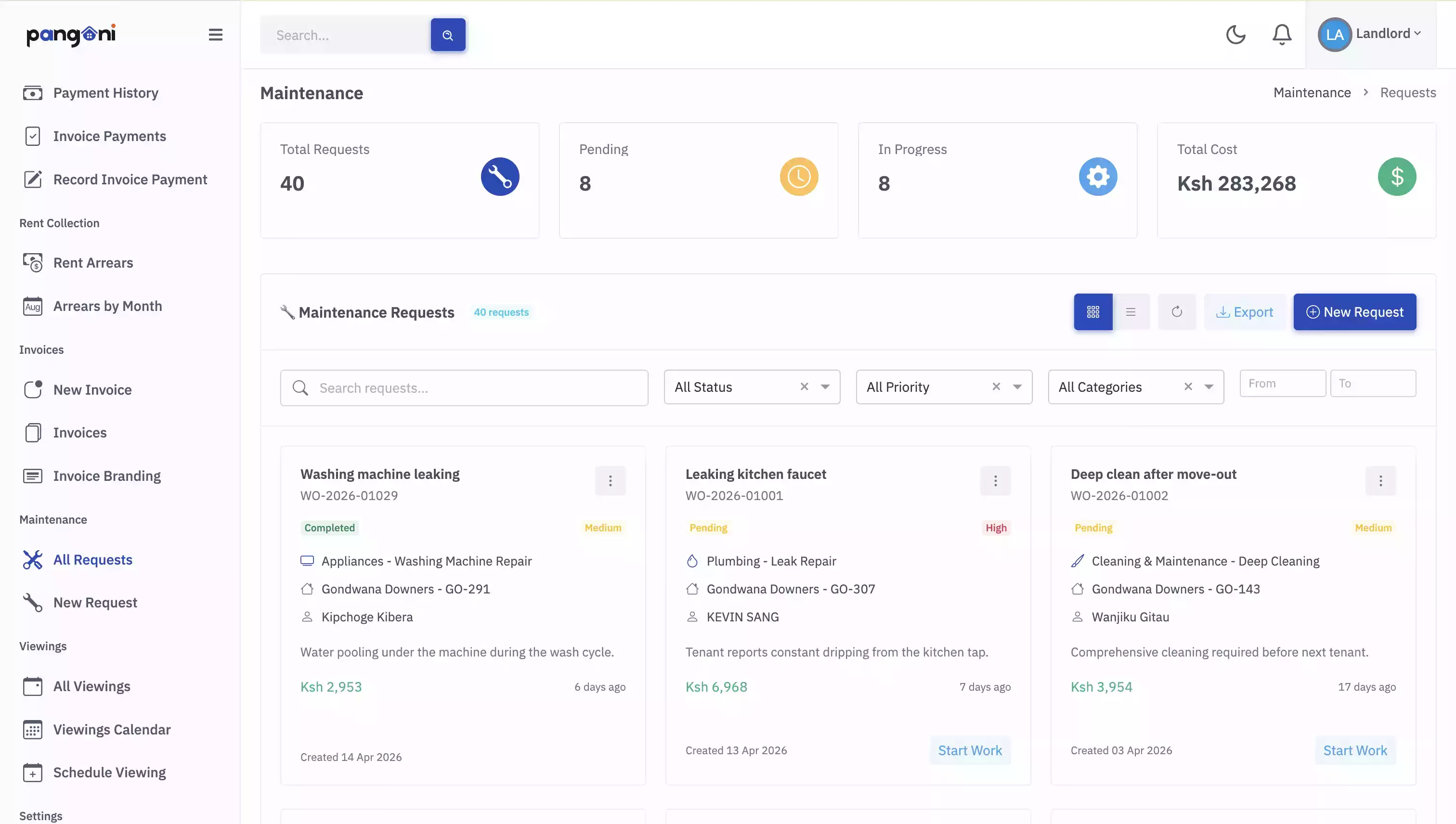
- Turn on Automated Alerts and Notifications. Choose the Maintenance module.
- Confirm the three default priority tiers (Urgent / Routine / Cosmetic) and their SLAs, or override the hours to match your portfolio's standards.
- Add your vendor list — names, specialties, phone numbers. Assign a default vendor per trade so the ticket auto-routes when a tenant files it.
- Set the escalation ladder intervals for each tier. Defaults are sensible; tweak for portfolio size.
- Turn on the tenant status-update channel. SMS for short updates, email for ones that carry a photo.
- Save. The next ticket a tenant files runs through the full system.
Frequently Asked Questions
Related: for the tenant-communication side, see Seamless Tenant Communication. For rent-specific reminders, see How to Set Up Automated Rent Reminders.